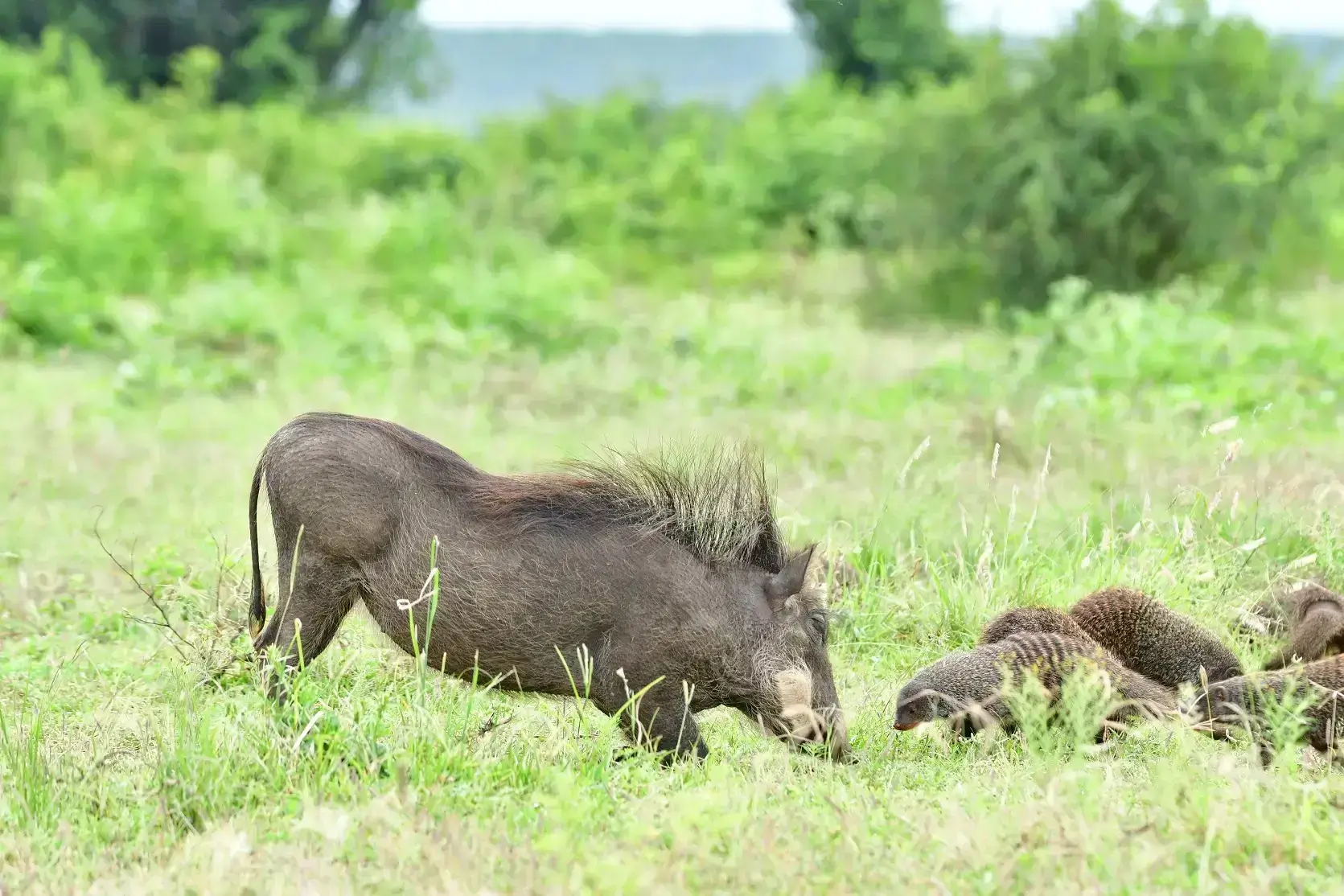
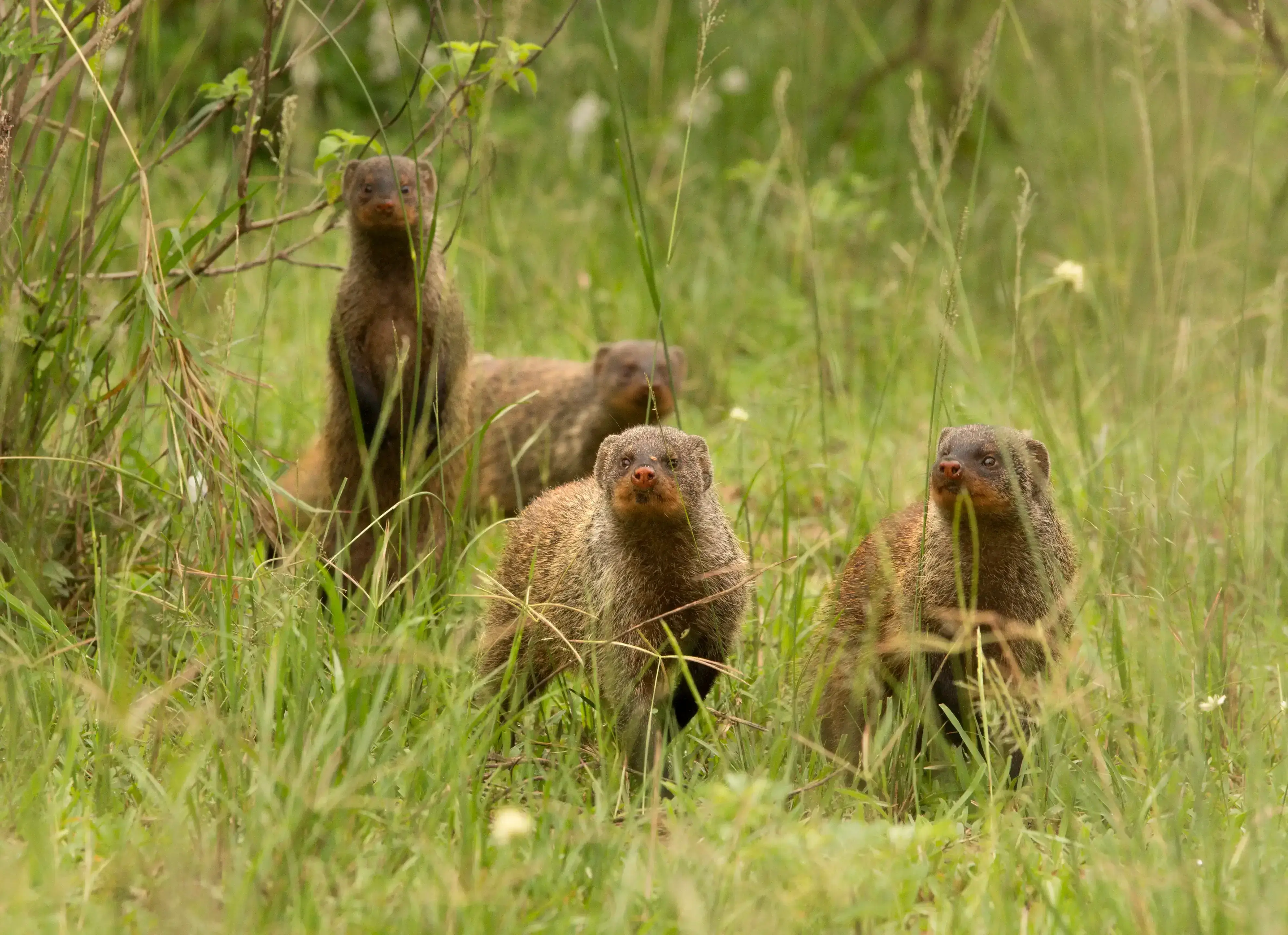
Banded mongooses are one of the most social members of the mongoose family (Herpestidae). They live in stable groups of around twenty animals of both sexes, plus their offspring, and defend year-round territories. They sleep together in an underground den, and set off each day on a foraging trip, digging up beetles and millipedes. Over the years we have uncovered many surprising and unusual features of banded mongoose social groups which make them an ideal system to test theories about how animal societies – including human societies – evolved. Below is a list of some of our main research themes.
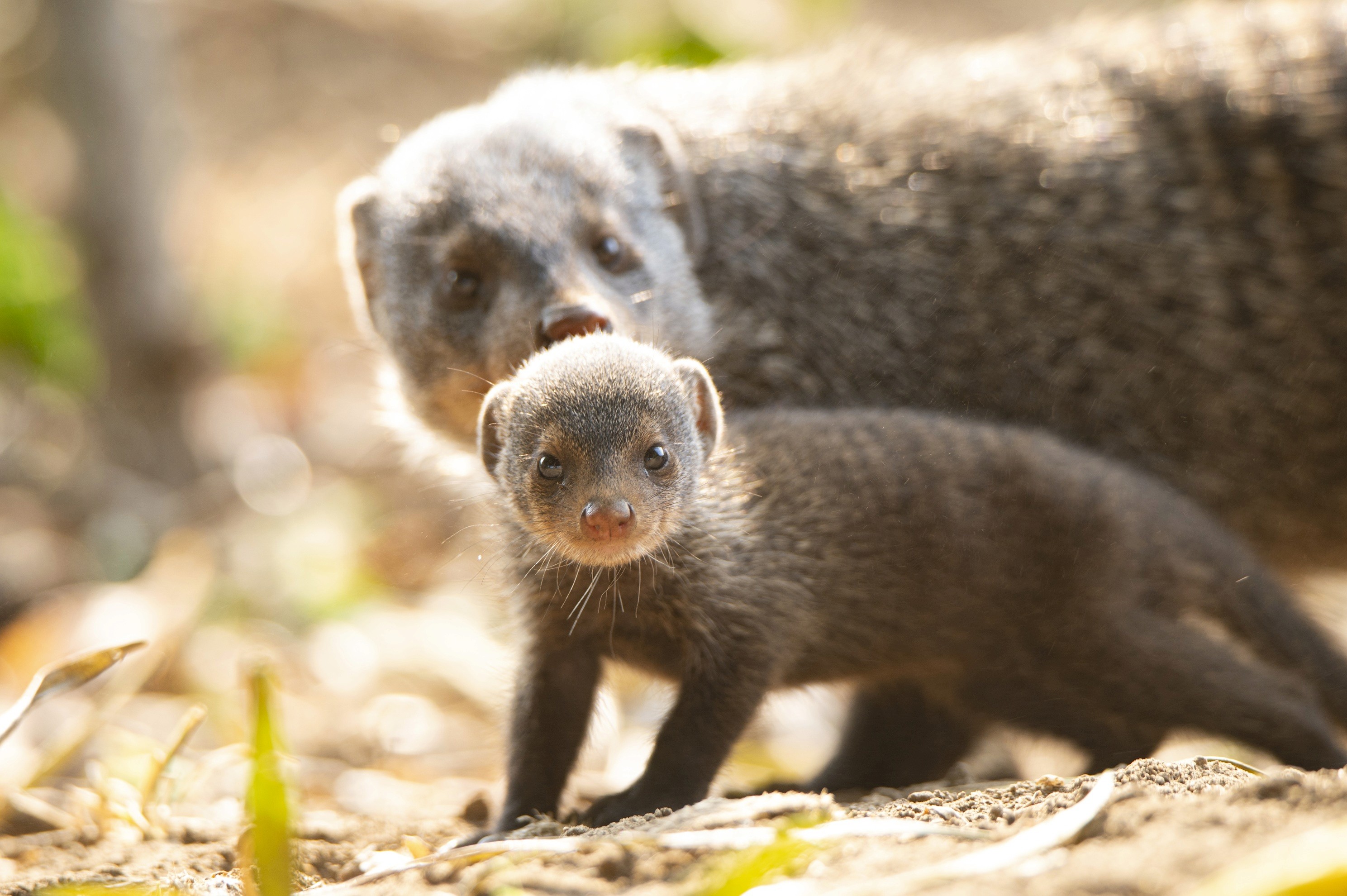
Banded mongooses are cooperative breeders: a breeding system in which some individuals reproduce and others, called helpers, focus on raising the offspring. Unlike other cooperative breeders however, helping in banded mongooses takes the form of ‘escorting’, where each helper forms a close bond with a single offspring which it feeds, protects, and teaches how to forage. Around four or five females in each give birth together on exactly the same day, which means that mothers can’t identify their own offspring in the communal litter. Since adults don’t know which pups are their own, they provide extra food to the smallest and weakest offspring, which has the effect of levelling out inequalities among pups and ensuring that the maximum number of young survive.
Read about escorting and birth synchrony in mongoose groups here.
Evolution of cooperation
Intergroup conflict
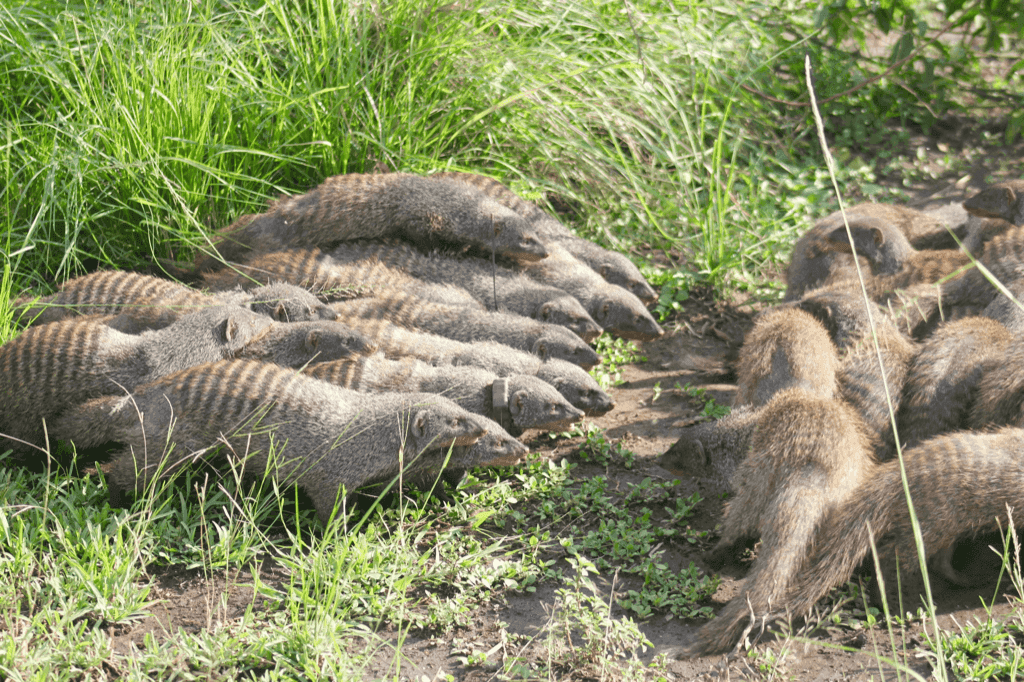
Banded mongooses are one of the most intensely warlike mammals on the planet. Mongoose groups are extremely territorial, and frequently enter into violent fights with their neighbours over food and mates. These fights can be deadly: rates of death in battle in banded mongooses are comparable to those observed in humans and chimpanzees. We know that many of these fights are started by females as a way of avoiding inbreeding. Females lead their group into encounters with neighbouring groups and use the chaos of battle to mate with rival males. Because we know almost everything about the individuals in our population, from birth to death, we can use the mongooses to test more general theories about the causes and consequences of warfare in animal societies. Our current research, funded by an ERC Advanced Grant, aims to unravel what drives groups to such extreme levels of conflict, and what factors might promote peace between groups.
Read some of our research findings here.
Life history evolution
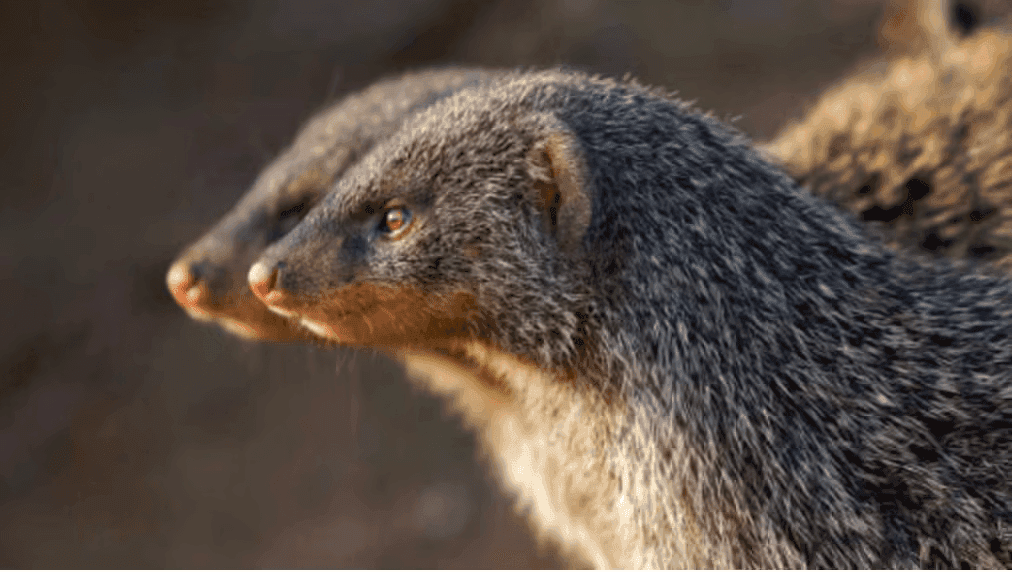
Life history refers to how animals grow, survive and reproduce across their lifespan. Testing how different patterns of life history evolved requires studies of animals living in their natural environment, exposed to natural predators and pathogens. Because of the detail and continuity of our data, the banded mongoose system has proved to be a powerful model system to test ideas about why some individuals develop faster, or age more quickly, than others. We have studied how conditions experienced early in life can have consequences for health and fitness in adulthood; and investigate why, unusually for social mammals, banded mongoose males live substantially longer lives than females.
How does collective behaviour emerge from natural selection acting on individual agents? This is a question of great current interest in biology. Banded mongooses exhibit many remarkable examples of collective behaviour, from the extreme birth synchrony of breeding females, to the collective battles which are fought by teams of male warriors. We are currently using drones and detailed tracking methods to investigate how groups remain cohesive as they move around their environment, how they coordinate to form ‘battle lines’ during intergroup conflicts, and how they decide which animals will stay behind to babysit offspring at the den.
Read about some of our findings on collective behaviour here and here.
Collective behaviour and coordination
Reproductive conflict
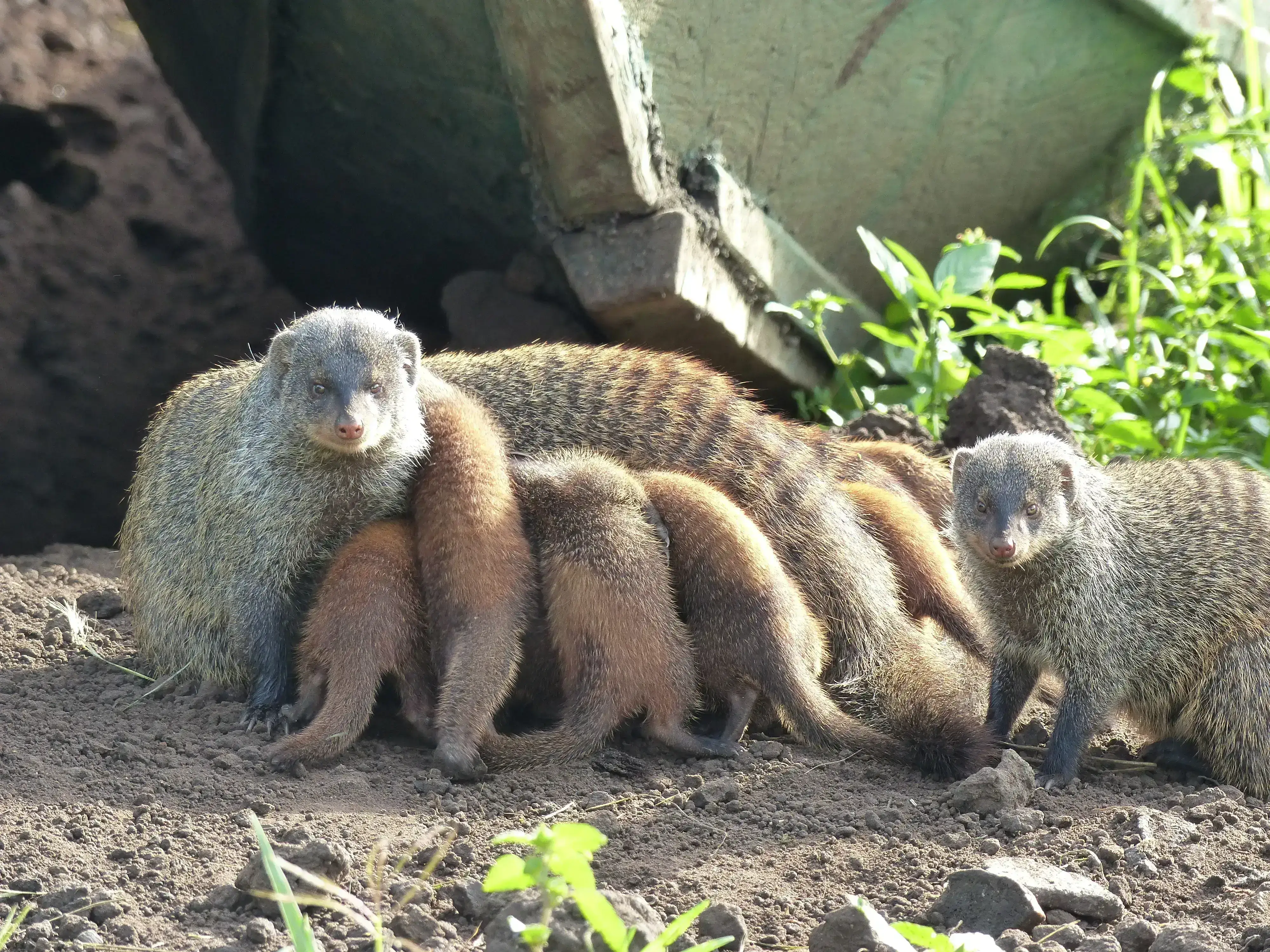
In most cooperatively breeding birds and mammals, reproduction is monopolised by one or two dominant female breeders. In banded mongooses, however, all females in the group older than one year can, and do, reproduce. For years we have tried to understand why reproduction is shared among females in this system. Our research has revealed that the answer lies in the extreme birth synchrony observed in this system, where all pregnant females usually synchronise their births to the exact same morning. By giving birth in perfect synchrony, females mix up the usual cues to maternity, removing the ability of dominant females to identify and kill the offspring of rival females. Synchronous birth is also the trick by which subordinate females escape the reproductive control of dominants.
Read more about this remarkable and unique birth system here and here.
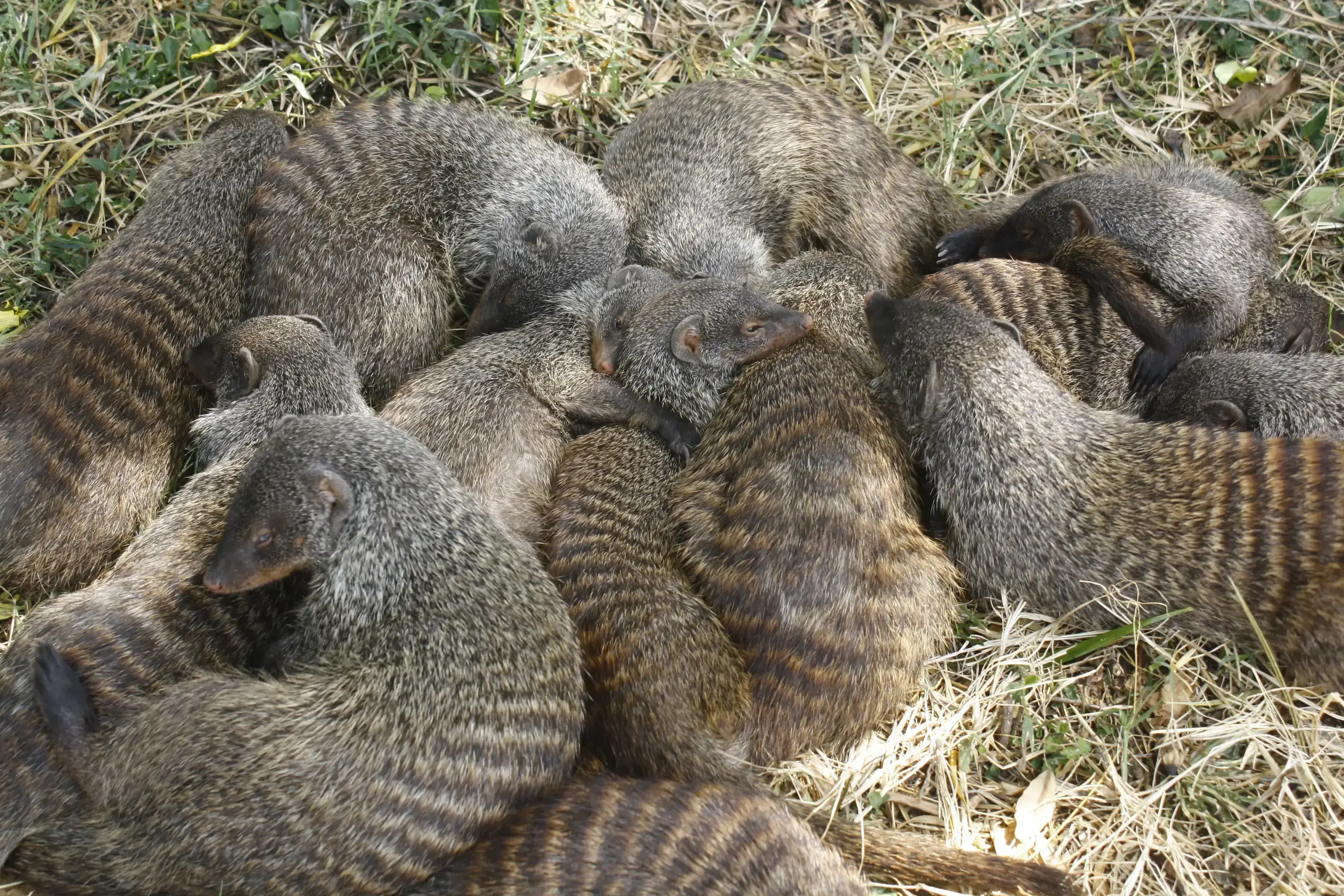
One of the downsides of living in tight knit groups, in which immigration is almost non-existent, is the risk of inbreeding. Female banded mongooses avoid inbreeding to some extent by mating with males from other groups. Over time, however, group members become genetically more similar to each other, leading to violent internal conflicts and the forced expulsion of groups of females, and sometimes groups of males too. These genetic drivers of conflict and dispersal have been uncovered by painstaking genetic analyses, revealing in exceptional detail how genetic factors shape the dynamics of the population.
Read more about our work on inbreeding and population structure here and here.
Inbreeding and population structure
Social learning
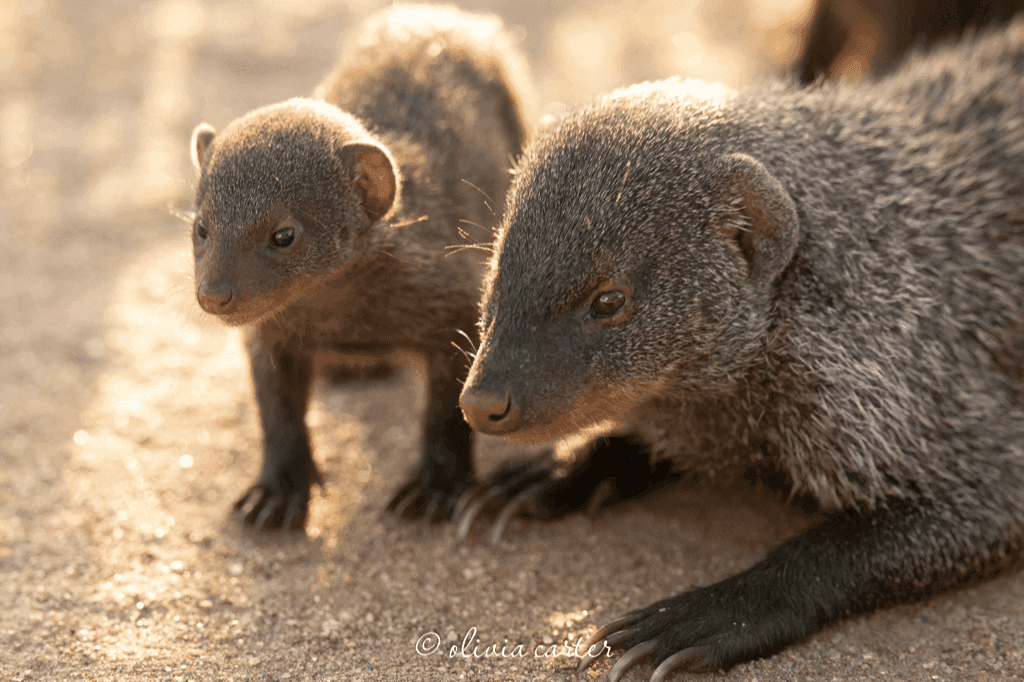
We can use the banded mongoose escort system as a natural cross-fostering experiment to disentangle genetic and cultural influences on development. We have shown experimentally that pups learn foraging techniques from their escorts via imitation. Using stable isotopes and genetic analyses, we have also demonstrated that pups inherit their lifelong foraging niche from their escort, not their genetic parents. Recently, we have uncovered evidence that escort cognitive skills affect the survival chances of the offspring in their care (but not in the way we expected!).
Banded mongooses are extremely vocal animals. While moving around in the bush they emit a constant stream of grunts and growls, occasional squeals and, when a predator is around, loud shrieks. We have studied the acoustic properties of these calls using innovative experiments and playbacks. Our studies have revealed that banded mongoose ‘contact calls’ – short, soft grunts – convey information about who they are and what they are doing. Effectively, their calls convey information such as ‘Amy, digging’, ‘Bob, walking’, and so on.
Read more about this remarkable aspect of their vocalisations (known as segmental concatenation) here.